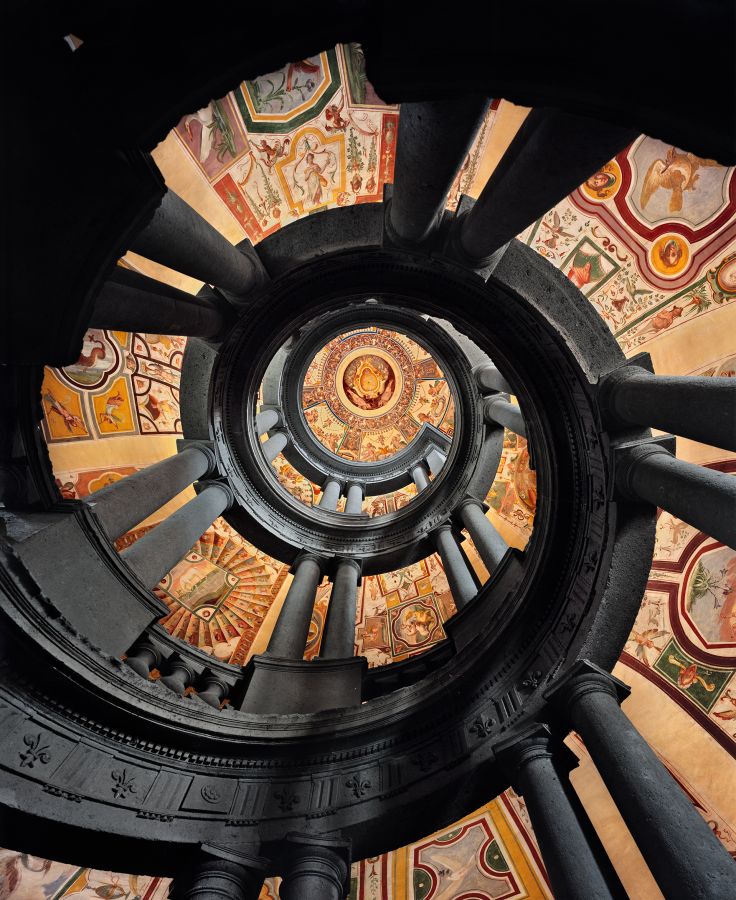
The exhibition Ahmet Ertuğ. Beyond the Vanishing Point in Venice presents 29 large-format photographs, with a focus on Italian architectural heritage and the dialogue it has woven over the centuries with the Mediterranean. Among the temples, cathedrals, palaces, libraries, and theatres of Italy, one work in the exhibition stands apart, returning Ertuğ to his origins: the sixth-century dome of Hagia Sophia. These images highlight the deep cultural ties between Istanbul and Venice, pivotal cities along the Silk Road. By opening access to hidden or inaccessible spaces, the photographs reveal architectural heritage as a timeless bridge between cultures and eras, and as a living testament to human imagination.
BEYOND THE VANISHING POINT
Ahmet Ertuğ’s photography arises from a profoundly architectural gaze, capable of traversing space to restore its original vision. Trained between East and West, the artist approaches each subject from the perspective of its designer, seeking an intimate dialogue between light, form, and memory.
Through the use of large format and long exposures, Ertuğ constructs images of extraordinary precision, in which natural light shapes space and amplifies its spiritual dimension. Within monumental interiors—from mosques to libraries, from theatres to sacred buildings—the gaze rises, offering a suspended perception of time and matter.
The images create a visual bridge between cultures and traditions, uniting technical rigor with aesthetic sensitivity. It is a visual narrative that invites viewers to pause, observe, and preserve the memory of places, suspended between monumentality and silence.
THE GAZE OF AHMET ERTUĞ
Ahmet Ertuğ was born in Istanbul in 1949 and trained as an architect, a path that profoundly shaped his way of seeing and interpreting space. For over fifty years, he has devoted his photographic research to European and Mediterranean architectural and cultural heritage, approaching each subject with a careful, respectful, and conscious gaze.
Through the use of large format and a slow, meditative process, Ertuğ produces images of extraordinary precision, capable of going beyond simple documentation. His photographs interpret the vision of the original architects and transform monuments, churches, theatres, and libraries into visual narratives suspended between light, memory, and silence.
Each photograph thus becomes an invitation to enter the depicted space and experience it as a total aesthetic experience, in which architecture, history, and perception merge into a timeless balance.